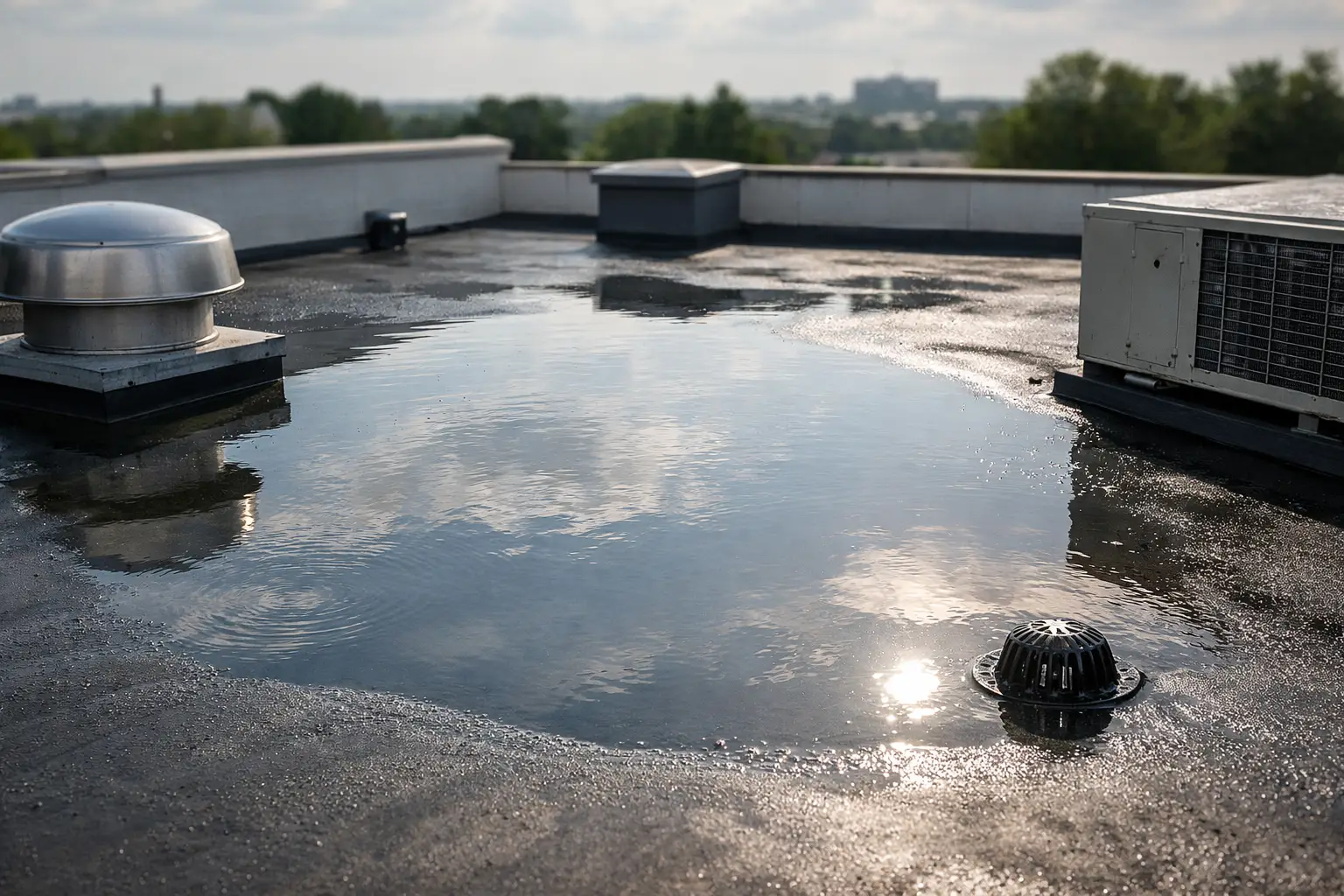
After a hard rain, a flat or low-slope roof should drain within a reasonable amount of time. If you keep seeing puddles that sit there day after day, you are right to pay attention. When property owners ask what causes ponding on roofs, the answer is usually not one single problem. It is a drainage issue with a backstory, and that backstory often involves age, design, weather, or neglected maintenance.
Ponding water is more than an eyesore. On a roof in New York City, standing water adds weight, stresses seams, speeds up membrane wear, and raises the risk of leaks around drains, flashing, and penetrations. On commercial buildings and multifamily properties, it can also turn a manageable repair into a larger restoration job if it keeps getting ignored.
What causes ponding on roofs most often?
In plain terms, ponding happens when water cannot move off the roof the way it was supposed to. On low-slope and flat roofing systems, the roof is designed to direct water toward drains, scuppers, gutters, or internal leaders. If that path is blocked, poorly pitched, or damaged, water stays put.
Sometimes the cause is obvious, like a clogged roof drain filled with leaves, debris, or roofing gravel. Other times, the problem is built into the roof system itself. A roof deck may have settled over time. The insulation may have compressed. The structure may have developed low spots that hold water after every storm. You can patch the symptom, but unless you identify the actual cause, the same puddles will keep coming back.
Poor drainage design
One of the biggest reasons roofs develop ponding is poor drainage design. Flat roofs are not truly flat. They need slope, even if it is slight, so water has somewhere to go. If the original roof installation did not create enough pitch, water may drift toward the wrong areas or stop in shallow depressions.
This matters on both older buildings and newer reroofing projects. We sometimes see roofs where a new membrane was installed over an existing problem without correcting the slope underneath. The roof may look clean on day one, but after a few storms, the same ponding pattern shows up again.
On larger commercial roofs, design issues can be harder to catch without a proper inspection. Water may collect far from a visible drain simply because the field of the roof was never balanced correctly. That is why drainage planning matters just as much as the membrane itself.
Not enough slope to drains
If water has to fight gravity to reach a drain, it is not going to get there. Even a durable roofing system like EPDM or TPO can struggle if the roof was not sloped properly from the start. Tapered insulation can often help correct this, but it has to be designed carefully.
Drain placement problems
A roof can also pond if drains, scuppers, or gutters are located in the wrong places. If the lowest point of the roof is not where the drainage opening is, water will sit in the low area instead of exiting the building.
Clogged drains, scuppers, and gutters
This is the most fixable cause, and it is also one of the most common. Roof drains clog with leaves, dirt, trash, roofing debris, and even nesting material. In city buildings, especially those surrounded by trees or exposed to wind-blown debris, drainage openings can block faster than many owners expect.
Once a drain clogs, water backs up and begins spreading across the roof surface. The longer it sits, the more likely it is to find weak seams, open laps, or flashing defects. In colder weather, standing water can also freeze and expand existing trouble spots.
The same goes for gutters and leaders. If the gutter line is full or the downspout is blocked, water cannot leave the system efficiently. It may overflow at the edge or back up onto the roof.
Structural settling and sagging
Some ponding problems come from the building itself, not just the roofing material. Over time, a roof deck can sag due to age, long-term moisture exposure, structural movement, or repeated loading from snow and standing water. Once the deck dips, it creates a low area that naturally traps water.
This is one of the more serious causes because it can point to structural wear, not just surface drainage issues. On older Bronx and Brooklyn buildings, we often see roof areas that have developed subtle depressions over many years. They are easy to miss from the ground, but after rainfall, the pattern becomes obvious.
There is also a cycle here that makes things worse. Ponding water adds weight. That extra weight can deepen weak spots in the deck. Deeper weak spots then hold even more water. If left alone long enough, what started as a shallow birdbath can become a real failure point.
Compressed or damaged insulation
On many flat roofing systems, insulation sits beneath the membrane and helps shape drainage. If that insulation becomes wet, crushed, or uneven, the roof surface can sink in spots. Water then collects in those depressions.
This often happens after repeated leaks or years of trapped moisture inside the system. Wet insulation loses performance and can no longer support the roof evenly. In some cases, the membrane still looks intact from above, but the surface feels soft or uneven underfoot. That is a warning sign that the problem may be below the visible surface.
The repair here depends on the extent of the damage. A small area may be cut out and rebuilt. A larger area may call for more extensive roof restoration or replacement.
Installation mistakes and poor repair work
Not every ponding problem comes with age. Some are created during installation or after low-quality repair work. If a contractor patches sections without thinking about water flow, they can unintentionally build up one area and trap water in another.
Flashing details, membrane transitions, and patch thickness all matter. On a low-slope roof, even small height differences can change drainage patterns. That is why piecemeal repairs should be done carefully, especially on older roofs with multiple prior patches.
You also see problems when new equipment gets installed on the roof. Curbs, supports, and penetrations can interfere with drainage if they are added without adjusting slope or redirecting water properly.
Weather, debris, and neglected maintenance
New York weather does roofs no favors. Heavy summer rain, wind-driven storms, snow load, ice, and freeze-thaw cycles all put pressure on drainage systems. A roof that drains acceptably in mild weather may show its weaknesses during a major storm.
Maintenance plays a big role here. Even a well-built roof can develop ponding if nobody clears debris, checks drains, inspects seams, or addresses minor low spots before they worsen. Property owners often wait until there is an interior leak, but ponding usually starts telling the story long before that.
This is where regular roof inspections earn their keep. They catch early warning signs like membrane wrinkling, open seams near low areas, drain strainers packed with debris, or soft spots around recurring puddles.
Why ponding water becomes expensive fast
Standing water shortens roof life. It increases surface wear, stresses joints, and creates more opportunities for water infiltration. If the roof already has vulnerable areas, ponding gives water time to work its way in.
There is also the cost of hidden damage. Moisture can soak insulation, rust metal components, stain ceilings, damage walls, and create interior disruption for tenants or businesses. In commercial properties, one drainage problem on the roof can turn into complaints from multiple units below.
The tricky part is that not every ponding issue means immediate replacement. Some roofs can be corrected with drain cleaning, minor structural adjustments, tapered insulation, or targeted repairs. Others have reached the point where continuing to patch them is just spending money twice. It depends on the age of the roof, the size of the ponding areas, the condition of the deck, and whether moisture has already spread into the system.
How to tell when ponding needs professional attention
A small amount of water right after a storm is not unusual on a low-slope roof. What matters is how long it stays and whether the same areas keep holding water. If puddles remain for more than 48 hours, or if you notice repeat leaks, soft spots, bubbling, interior staining, or visible sagging, it is time to get the roof checked.
A proper inspection should look beyond the puddle itself. The goal is to find out whether the issue is caused by blockage, slope failure, wet insulation, structural movement, or bad prior work. Without that step, even a decent repair can miss the mark.
At Global City Restoration, the practical approach is simple: show the owner what is happening, explain why water is not draining, and recommend the repair that actually fits the condition of the roof. Some jobs need maintenance. Some need reconstruction in problem areas. Some roofs are telling you they are done.
If your roof keeps holding water after storms, do not treat it like a normal part of flat roofing. Ponding is usually a sign that the roof is asking for help, and the earlier you answer it, the more options you keep on the table.