A lot of building leaks in New York start outside, not overhead. Water misses a clogged gutter, backs up at the roof edge, runs down masonry, and suddenly you are dealing with stained walls, damaged fascia, cracked foundation areas, or interior moisture that should have been avoided. That is why gutter and leader repair NYC property owners schedule quickly is not a small maintenance item. It is basic exterior protection.
In this city, drainage systems work harder than many owners realize. Sudden summer downpours, winter freeze-thaw cycles, wind-driven debris, and older building layouts all put extra stress on gutters and leaders. On a single-family home, that can mean roof edge rot and basement seepage. On a multifamily or mixed-use property, it can mean repeated facade staining, pooling near entrances, and complaints from tenants or commercial occupants.
Why gutter and leader repair NYC buildings need is different
New York properties do not all drain the same way. A detached house in the Bronx, a brownstone in Brooklyn, and a commercial building in Queens can each have a very different gutter and leader setup. Some systems are older and patched many times. Some were undersized from the start. Others are blocked because nearby trees drop leaves and debris faster than owners can keep up with.
The city environment makes small defects worse. Tight lot lines leave less room for water to disperse safely. Sidewalk traffic means overflowing water becomes a safety issue. Brick, stucco, siding, and trim can all take a hit when runoff is not controlled. What looks like a minor separation at a joint can turn into long-term exterior damage if rainwater keeps hitting the same area.
That is why repair work should not be treated as a generic handyman task. The system has to move water efficiently, stay secured in place, and discharge properly without creating new problems lower down.
Common signs your gutter or leader system is failing
Most owners do not inspect gutters closely until water starts showing up where it should not. By then, the issue is usually bigger than a simple cleaning.
Overflow during rain is one of the clearest warning signs. If water spills over the gutter edge instead of moving into the downspout, the problem may be a blockage, bad pitch, or a leader that cannot keep up with roof runoff. Sagging sections are another red flag. Gutters that pull away from the fascia often have loose fasteners, hidden rot behind the attachment points, or too much standing debris weight.
You may also notice water marks on siding, peeling paint near roof edges, rusted seams, or puddling near the foundation. On masonry buildings, repeated overflow can leave dark streaks and contribute to mortar deterioration over time. In colder months, ice buildup along the gutter line can point to drainage trouble or poor water flow through the leaders.
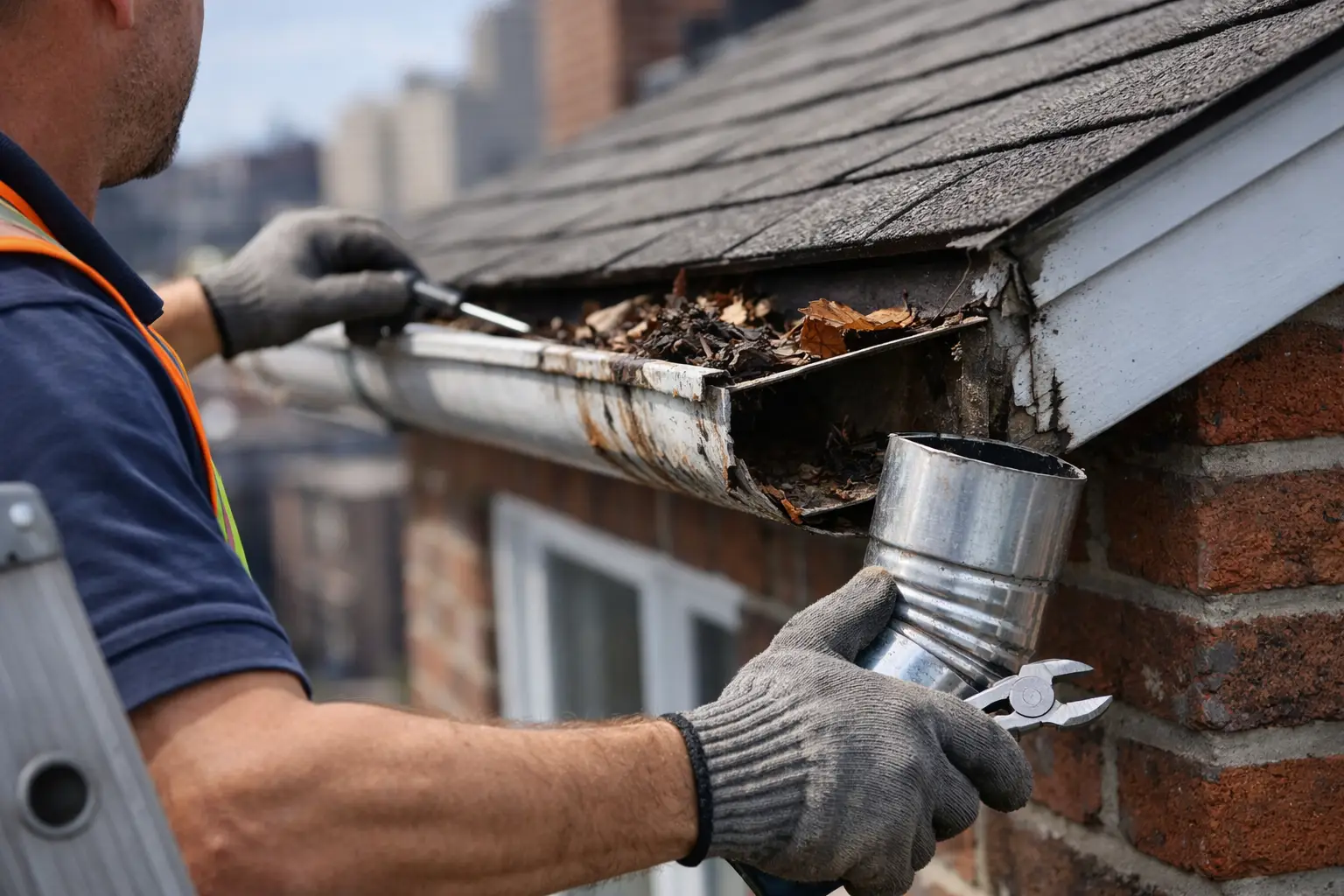
If the downspout or leader is cracked, disconnected, crushed, or draining too close to the building, the system is not doing its job even if the gutter itself looks fine. Many leaks blamed on the roof actually start with water being forced back into vulnerable areas because the drainage path is blocked or broken.
What usually needs repair
Not every drainage problem requires full replacement. In many cases, targeted repair is the right move, especially when the existing system is still structurally sound.
Seam resealing is common on older metal gutters. Joints can open over time, especially after repeated expansion and contraction. Refastening loose hangers or brackets is another frequent repair, but it only works if the wood behind the gutter is still solid. If fascia boards are rotted, that has to be addressed first or the gutter will fail again.
Leaders often need reconnection at elbows and upper joints where movement and clogging put extra stress on the system. Some are simply too narrow for the roof area they serve, which means repair may involve selective replacement with better-sized components. In other cases, sections have to be re-pitched so water actually flows to the downspout instead of sitting in the channel.
For buildings with repeated clogs, the fix may include correcting how debris enters the system, not just clearing the line. Screens and guards can help in some cases, but they are not a cure-all. On certain properties, especially where roofs shed a lot of granules or leaves, guards can still require maintenance and may even complicate cleaning if installed poorly.
Repair or replacement? It depends on the condition
This is where honest evaluation matters. A good contractor should tell you when repair is enough and when replacement makes more financial sense.
Repair is usually the better option when damage is isolated, the metal is still in decent shape, and the system was properly designed to begin with. If one corner leaks, a bracket came loose, or a leader connection failed after a storm, repair can be fast and cost-effective.
Replacement is often smarter when the system has widespread rust, multiple failed seams, repeated pitch problems, or chronic overflow because the original layout was wrong. If sections have already been patched several times, more repairs may just delay the inevitable. The same goes for systems attached to deteriorated trim or fascia. Fixing the gutter without fixing the substrate underneath is money spent twice.
For landlords and property managers, replacement can also reduce repeat service calls. If tenants keep reporting overflow, icing, or water at entry paths, a piecemeal approach may cost more over time than installing a proper drainage setup once.
What the repair process should look like
A professional repair job starts with inspection, not guesswork. The visible leak point is not always the source. Water can travel along edges, behind trim, or down wall surfaces before it shows itself.
The contractor should check the gutter runs, seams, fasteners, pitch, downspout connections, discharge points, and the condition of nearby fascia or exterior surfaces. On some properties, roof drainage patterns also need to be reviewed because the issue is not just in the gutter. If too much water is being concentrated into one section, the repair plan has to address that.
Once the condition is clear, the scope should be straightforward. You should know what is being repaired, what materials are being used, whether damaged wood or trim is involved, and whether the system will need partial replacement in certain areas. For NYC properties, code compliance and safe discharge matter. Water should be directed away from vulnerable building areas, not dumped where it can create another issue.
At Global City Restoration, that kind of repair is approached as part of full exterior protection. Gutters and leaders are not treated as isolated parts. They are tied to roof edges, fascia, siding, masonry exposure, and the building’s overall drainage performance.
Cost factors owners should expect
There is no single flat rate for gutter and leader repair because building conditions vary so much. Height, access, material type, extent of damage, and whether wood repair is needed all affect pricing.
A simple reconnection or reseal costs far less than rebuilding multiple runs with fascia repair. A two-story home with easy ladder access is a different job from a mixed-use property with rear yard constraints or difficult roof lines. Emergency calls after storms may also cost more than planned service.
The cheapest fix is not always the lowest-cost decision. If a contractor skips the underlying cause, such as rotten attachment points or a badly pitched run, you may be paying again after the next hard rain. Clear diagnosis saves money.
Why fast action matters
Gutter problems tend to spread. Water reaches places it should not, and the damage keeps building quietly. What starts as a loose leader can turn into masonry staining, soffit damage, mold-prone moisture, or foundation saturation around the perimeter.
For commercial properties, drainage failures can also affect storefront appearance, customer access, and liability exposure when runoff freezes. For homeowners, it can mean expensive repairs to trim, siding, landscaping, and even basement areas. Quick repair is usually far cheaper than waiting for visible interior damage.
If your gutters are overflowing, separating, leaking at seams, or sending water back toward the building, it is time to get them looked at. Good drainage protects everything below it. When the system works, most people never think about it. That is exactly how it should be.